Flat Clearance Mill Hill — Recycling and Sustainability
Flat Clearance Mill Hill is committed to setting a new standard for eco-friendly waste disposal area practices across the borough. Our approach to flat clearance in Mill Hill focuses on reducing landfill reliance, increasing reuse, and supporting the local circular economy. This page explains how our Mill Hill flat clearance service integrates with municipal waste separation schemes, local transfer stations and charity partnerships to deliver a truly sustainable rubbish area model.
We work closely with the borough's waste separation policy, which encourages residents to sort glass, mixed plastics, paper, food waste and textiles at source. By aligning with that policy, our flat removals Mill Hill teams separate materials on-site and redirect items to the correct processing streams. This reduces contamination rates and helps the area meet strict recycling targets set by local authorities and environmental regulators.

Recycling percentage target: our operational goal for each clearance is to achieve a minimum 75% diversion from landfill by weight. That target reflects an ambitious but achievable combination of reuse, repair, redistribution and material recycling. We monitor performance by recording the tonnage of materials sent to recycling facilities and the percentage of items donated through charity partners.
Low-Carbon Vans and Transport
To operate a sustainable rubbish area, transport emissions are critical. Our fleet includes low-carbon vans and purpose-built small trucks designed for urban access in Mill Hill. Low-carbon vans reduce CO2 and NOx per job, and route planning software minimizes mileage and idle time. For particularly large clearances we combine loads to a single trip to local transfer stations, reducing overall vehicle movements across the borough.Vehicles are cleaned and maintained to high standards to preserve fuel efficiency, and drivers follow eco-driving practices as standard. Where appropriate we schedule electric or hybrid vans for short urban hops, further lowering the carbon footprint associated with flat clearance in Mill Hill.
Local transfer stations and processing
We send sorted loads to authorised local transfer stations and material recovery facilities that serve Mill Hill and neighbouring boroughs. These transfer stations are selected based on their recycling performance and environmental permits. Examples of typical processing flows include:- Glass and ceramics collected separately and routed to glass cullet plants.
- Paper and cardboard baled for pulping and recycling.
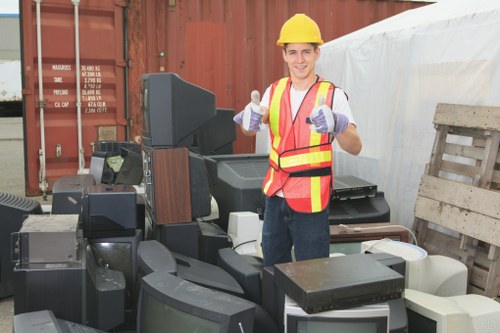
- Metals and WEEE (waste electrical and electronic equipment) taken to authorised recyclers for safe recovery of components and hazardous substances.
 Textile and furniture reuse is a priority — good condition sofas, wardrobes and clothing are photographed and assessed for donation or resale rather than shredding or incineration. Where items are beyond reuse, we ensure responsible recycling processes are used.
We maintain records of all transfers and provide anonymised statistics to local authorities to support borough-wide recycling targets. That transparency helps local waste planners measure the effectiveness of sustainable rubbish area initiatives and inform future policy.
 Charity partnerships and community benefit: a core part of our Mill Hill flat clearance operations is partnering with local charities and social enterprises. These partnerships enable functional household items to be diverted to community use, supporting local families and reducing the need for raw materials. We collaborate with charities that collect:
- working appliances and small electrical goods;
- usable furniture and bedding (following safety checks);
- clothing and paired shoes.
Items unsuitable for direct donation are repaired or stripped for parts by partner organisations wherever feasible. This not only extends product lifecycles but also provides training and employment opportunities within the borough.

Operational best practices include site audits, segregation audits and regular staff training. Before any Mill Hill flat clearance, teams complete a quick assessment to identify hazardous materials (paints, solvents, asbestos suspected items) and ensure these are dealt with by licensed handlers. Our rubbish area protocols prioritize recovery pathways over disposal and maintain safe, clean sites during and after clearances.
To support the local waste hierarchy we actively promote reuse and repair. Where household goods are salvageable we coordinate collection times with charity partners to allow direct handover. For smaller items we run dedicated collection days that feed into textile banks and electronics recycling streams operated by accredited processors in the region.
We track performance metrics including tonnes diverted, number of beneficiary donations and estimated CO2 savings from low-carbon transport choices. These metrics help us refine the service and push toward an even higher target: a staged ambition to reach 85% diversion across specific project types within two years.
Why this matters: an eco-friendly waste disposal area and sustainable rubbish area mindset reduces environmental impact, supports local charities, and keeps Mill Hill cleaner and healthier. Our flat clearance service in Mill Hill is not just clearing space — it is building a practical, measurable model for sustainable resource management that complements borough waste separation strategies and strengthens community resilience.